Jupiter
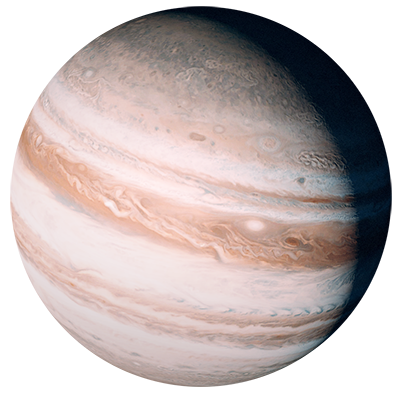 Jupiter is the 5th planet from the Sun and is the largest. Jupiter is named after the Roman god of the same name.
Jupiter's symbol (♃) represents the thunderbolt of the Roman god Jupiter (Zeus in Greek mythology) or an eagle, his sacred animal. It is also associated with expansion, growth, and wisdom in astrology.
List of Satellites
Inner Satellites
Galilean Satellites
Jupiter's Galilean Moons

A NASA composite image showcasing the four largest moons of Jupiter: Io, Europa, Ganymede, and Callisto.
Topic Specific Questions
Explain what creates the belts and zones in Jupiter’s atmosphere.
Jupiter’s fast rotation creates strong jet streams, separating its clouds into dark belts and bright zones across long stretches. Jupiter rotates at a blazing speed of 10 hours per rotation.
Explain why storms on Jupiter can remain stable and last for so long.
With no solid surface to slow the storms down, they can keep going and going for years..
Why are there so many fewer craters on Io and Europa than on Callisto and Ganymede?
Io’s surface is constantly being recreated with the volcanoes on its surface. The molten lava creates new land over any craters. Europa on the other hand has a layer of ice moving slowly due to the large ocean underneath its surface. Practically erasing the impact creators.
Explain the reason why scientists believe there is an ocean on Europa and how this relates to the extreme volcanism on Io.
The tidal forces from Jupiter constantly stretch and squeeze the surfaces of both Io and Europa. For Io it causes its extreme volcanic activity. While for europa it cracks the Ice. Scientists have observed that the way the ice cracked on Europa's surface is not fully caused by the tidal forces and can only be explained by a liquid interior.
Fact Sheet!
Mass
Equatorial Radius
Orbitial Radius
Day Length
Year Length
Axial Tilt
Average Surface Temperature
Average Surface Pressure
317.8 times Earth
71,492 KM
5.2 Astronomical Units
9.9 Hours
11.86 Earth years
0.01 Degrees
-108 C (-163 F)
1 Bar
Gallery (hover over the images for a description)
JUNO


What is JUNO?
Juno is a NASA spacecraft launched in 2011 to study Jupiter. It orbits the planet to investigate its atmosphere, magnetic field, gravity, and deep interior structure, helping scientists understand Jupiter’s formation and evolution.
How was Jupiter formed?
When the Solar System formed, Jupiter took shape as most of the mass left over from the Sun went into Jupiter. Jupiter’s mass is more than twice the combined material than all the other bodies in the Solar System.
What is Jupiter made of?
Kind of lame but it's just mostly hydrogen and helium. With the immense pressure of all that mass, the hydrogen and helium actually transitions into a liquid state.
Does Jupiter have a magnetic field?
Yes! The pressure also makes the gas giant magnetic. With the pressure so great, the electrons are stripped off the hydrogen atoms and makes it conductive. The quick rotation drives an electrical current through and thus produces a very powerful magnetic field.