Mercury

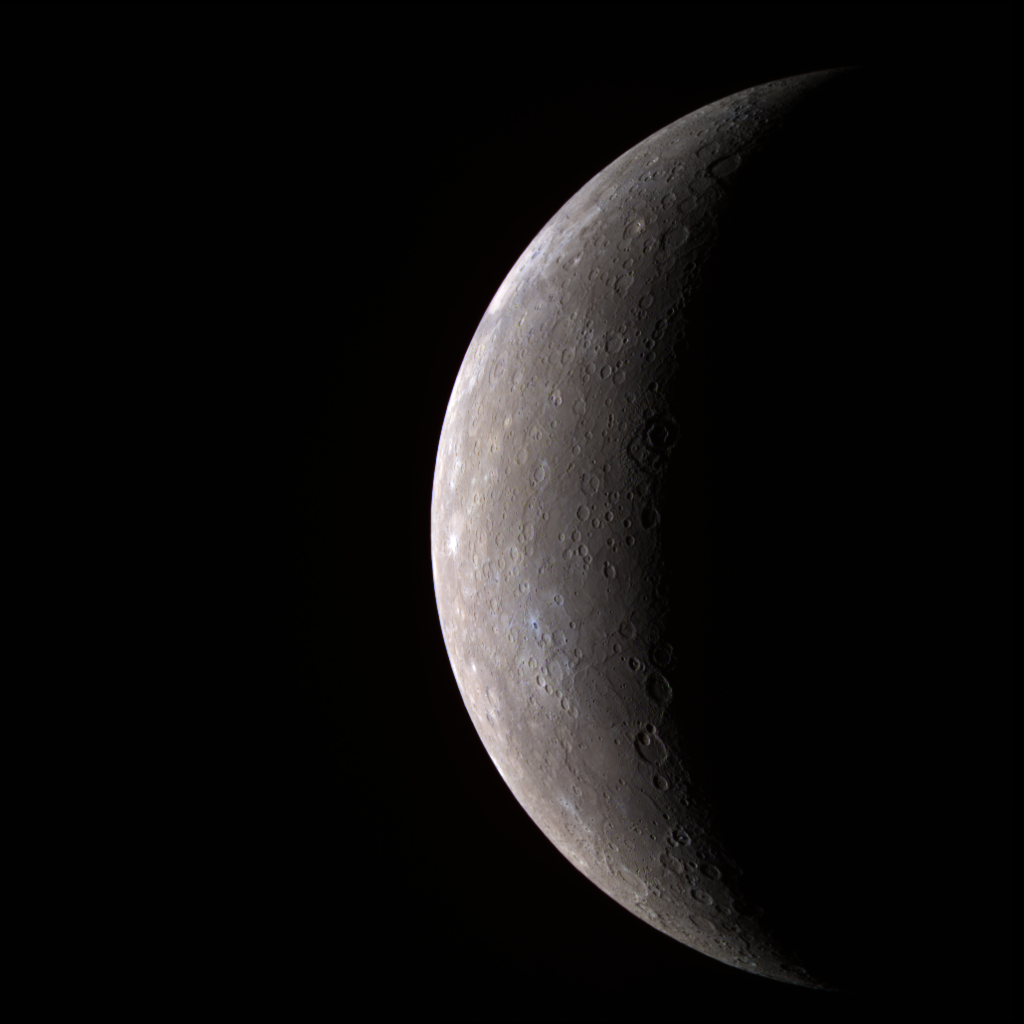
Named after the Roman messenger god, Mercury is the closest and smallest of the planets. (sorry Pluto). Its surface is full of craters just like the Moon.
The symbol for Mercury is a circle with a cross below it and a semicircle (representing a winged helmet) on top. ☿
List of Satellites
Topic Specific Questions
How does its rotation and revolution compare with that of the other terrestrial planets? Mercury’s revolution is the shortest of the planets, given its distance to the sun.
Mercury’s revolution is the shortest of the planets, given its distance to the sun. However, it's got a sizable rotation time compared to the others. It takes little Mercury a whole 58 3/5ths of Earth’s days to rotate once.
What is “Tidal coupling” and how is it similar and dissimilar to that of coupling between the earth and moon?
It’s a common misconception that Mercury is completely tidally locked to the sun. While Technically correct, it’s not what most people think. The planet actually makes 3/2 rotations in one orbital period of the planet. Compared to the moon where it takes the same time to orbit the Earth as it does to rotate.
What is the difference between “intercrater plains” and “smooth plains”?
Intercrater plains are relatively flat areas located between the larger craters that are heavily cratered with small craters, indicating that they are pretty old. However “smooth plains” are flatter and primarily come from volcanoes which means they are newer.
Explain the possibility of a “partially” molten core.
Mercury has a HUGE core compared to other planets. Its metal core takes up 85% of its entire volume. Just like Earth, Mercury has a partially molten core. An inner core that is completely solid and an outer core that is molten. Even though Mercury is the second hottest planet in the solar system, its core has cooled at an unusually fast rate. Half of Mercury’s core is cooled compared to Earth’s only ⅓ cooled core.
Diagram of Mercury's layers

Mercury formed about 4.5 billion years ago when gravity pulled swirling gas and dust together to form this small plane. Like its fellow terrestrial planets, Mercury has a central core, a rocky mantle, and a solid crust. Mercury has a large (radius of 2,074 kilometers)metallic core made up of mostly iron. The outer mantle is only about 600 kilometers thick. Mercury has a very thin exosphere. It’s composed mainly of oxygen, sodium, hydrogen, helium and potassium. Mercury also barely has a magnetic field. About 1% the strength of Earth’s. It is generated by the moving liquid iron in the core.
Fact Sheet!
Mass
Equatorial Radius
Orbitial Radius
Day Length
Year Length
Axial Tilt
Average Surface Temperature
Average Surface Pressure
0.055 of Earth’s.
2,440 km (1,516 mi)
0.387 Astronomical Units
58.65 Earth Days
87.97 Earth Days
0.01 Degrees
167 C (although this varies wildly because of how close Mercury is to the Sun.)
0
Gallery (hover over the images for a description)
MESSENGER:


FAQ
Could we inhabit Mercury one day?
Mercury’s environment is a little too extreme and full of solar radiation for life to settle. Mercury’s sunny side is the second hottest place in the planetary system. The dark side isn’t much better, it’s incredibly cold because there’s not really an atmosphere to keep heat in. The solar radiation is also incredibly harsh due to how close Mercury is to the Sun. You WILL be blasted with large quantities of UV rays. It’s also pretty small, only slightly bigger than our moon. Living on the moon is probably better, the slight increase of size isn't worth the torment of living on Mercury.